Platforms

Prospective multicenter platforms presented in a standardized record.

Each CESOR platform uses the same public structure: status, rationale, design, eligibility, time zero, treatment strategies where relevant, outcomes, embedded causal questions, governance, and outputs.

Last updated: 2026-05-04

Active records

Current CESOR platform architecture.

Public descriptions are kept high-level and aligned to program structure rather than full protocol text.

SnapChole

Acute calculous cholecystitis

Active

Rationale

SnapChole is a prospective multicenter platform in acute calculous cholecystitis that characterizes diagnostic pathway, index management strategy, definitive source control, and 90-day downstream biliary utilization under real-world conditions.

Design

International, multicenter, time-bound prospective observational cohort study using standardized snapshot methodology and routinely collected clinical data.

Eligibility

Adults presenting for acute care with protocol-defined acute calculous cholecystitis. Exclusions include acute acalculous cholecystitis, primary gallstone pancreatitis, primary choledocholithiasis, acute cholangitis, and elective chronic biliary admissions.

Time zero

The first documented definitive disposition decision after completion of the initial diagnostic workup for suspected acute calculous cholecystitis.

Treatment strategies

  • Discharge without definitive source control
  • Inpatient non-operative management with interval intent
  • Index-admission cholecystectomy
  • Gallbladder drainage

Outcomes

Primary outcome: 90-day unplanned biliary acute-care utilization. Secondary outcomes include recurrent biliary presentation, urgent intervention, readmission, length of stay, mortality, and definitive source control by discharge.

Embedded causal questions

The platform supports restricted comparative analyses of pathway assignment and source-control strategy in clinically coherent subgroups using explicit estimands and aligned time zero.

Governance and outputs

CESOR-coordinated multicenter platform with protocol-based site onboarding and standardized public reporting. ClinicalTrials.gov registration: NCT07568080. See Outputs for methodologic and platform-linked publications, or open the dedicated SnapChole study page.
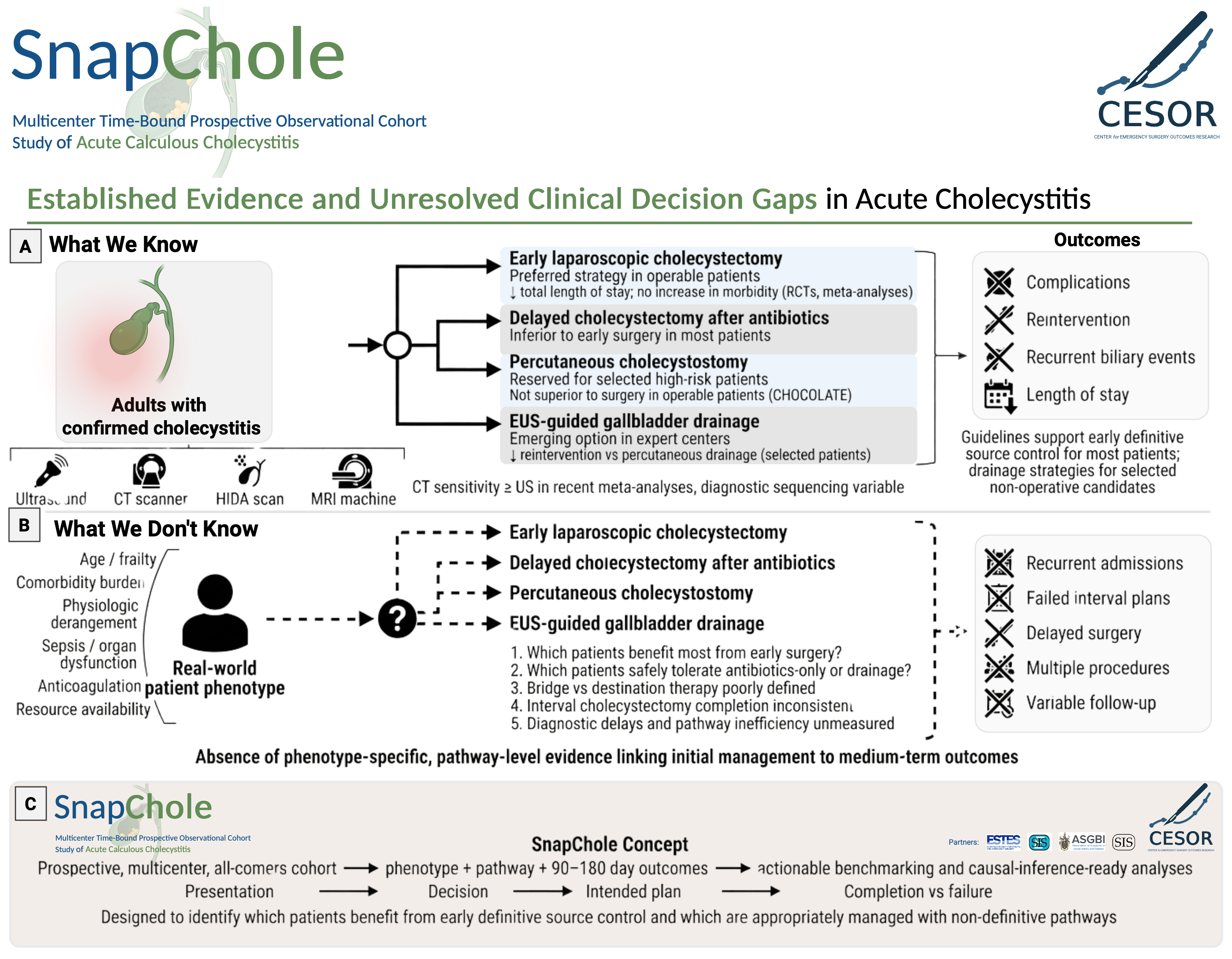
SnapChole rationale figure

SnapNSTI

Necrotizing soft tissue infection

Active

Rationale

SnapNSTI addresses one of the highest-acuity emergencies in surgery by capturing variation in diagnosis, debridement timing, antimicrobial management, adjunctive therapies, and 90-day outcomes.

Design

International prospective multicenter cohort platform using consecutive real-world case capture and standardized variable definitions.

Eligibility

Adults presenting with necrotizing soft tissue infection managed within participating acute care systems.

Time zero

Index acute presentation with protocol-defined eligibility and platform entry.

Treatment strategies

  • Initial operative source control pathway
  • Adjunctive antimicrobial and critical care pathway characterization
  • Escalation and repeat debridement patterns

Outcomes

Early source-control timing, organ support use, morbidity, mortality, reintervention, and short-term recovery outcomes.

Embedded causal questions

The platform supports analyses of timing and pathway effects where treatment strategy and follow-up can be aligned explicitly.

Governance and outputs

Multicenter collaborative governance with CESOR-aligned standardized reporting. ClinicalTrials.gov registration: NCT07107555. Open the dedicated SnapNSTI study page.

IMPEL

Mechanical large-bowel obstruction

Active

Rationale

IMPEL characterizes contemporary diagnostic and therapeutic strategies in mechanical large-bowel obstruction and links them to critical short-term outcomes.

Design

Prospective international snapshot audit of consecutive adult patients presenting with mechanical large-bowel obstruction.

Eligibility

Adults presenting with protocol-defined mechanical large-bowel obstruction within participating centers.

Time zero

Initial acute presentation and pathway assignment within the index admission.

Treatment strategies

  • Non-operative initial management
  • Urgent operative intervention
  • Stoma-forming and non-stoma operative pathways

Outcomes

Morbidity, mortality, critical care use, operative approach, and stoma-related outcomes.

Embedded causal questions

The platform supports comparative questions on strategy selection and downstream outcomes in clinically coherent subgroups.

Governance and outputs

Standardized multicenter platform governance coordinated through CESOR with partner-society representation. ClinicalTrials.gov registration: NCT07458867. Open the dedicated IMPEL study page.

PHAROAH

Physiologically hazardous airway

Active

Rationale

PHAROAH examines airway strategy, preparation, and peri-intubation outcomes in adults with a physiologically hazardous airway across acute care settings.

Design

International multicenter prospective snapshot audit of adult inpatient tracheal intubations in high-risk physiologic states.

Eligibility

Adults undergoing inpatient tracheal intubation under protocol-defined physiologic hazard conditions.

Time zero

The index intubation episode at the point of airway strategy execution.

Treatment strategies

  • Airway preparation pathway
  • Primary intubation strategy
  • Rescue and escalation strategy characterization

Outcomes

Early peri-intubation adverse events, rescue patterns, physiologic deterioration, and immediate airway-related outcomes.

Embedded causal questions

The platform informs analyses of airway preparation and execution strategies where decision nodes can be explicitly defined.

Governance and outputs

Prospective multicenter governance with implementation, quality-improvement, and interventional applications anchored to the platform architecture.

EGS-READI

Emergency surgery readiness and implementation

Active

Rationale

EGS-READI studies whether emergency general surgery services are structurally ready to adopt enabling technologies and digitally supported acute care pathways.

Design

Cross-sectional environmental scan and systems research platform focused on implementation readiness across emergency general surgery services.

Eligibility

Participating emergency general surgery services and institutional acute care environments under defined readiness assessment criteria.

Time zero

Institutional assessment at the time of structured readiness measurement.

Treatment strategies

Not applicable as a platform-level intervention comparison; the focus is readiness, adoption determinants, and workflow structure.

Outcomes

Readiness profiles, implementation barriers, enabling infrastructure, and system-level determinants of adoption.

Embedded causal questions

The platform informs implementation studies on how structural readiness relates to uptake and downstream performance.

Governance and outputs

CESOR-aligned systems research platform with structured reporting of readiness domains and implementation-relevant findings.

PONG

Postoperative nasogastric management

Active

Rationale

PONG addresses the common but weakly standardized problem of postoperative nasogastric tube management and its relation to recovery outcomes.

Design

Programmatic platform beginning with practice-pattern surveys and a prospective snapshot audit structured for target-trial-aligned analyses.

Eligibility

Patients and clinical settings meeting protocol-defined criteria for postoperative nasogastric tube management pathway assessment.

Time zero

Postoperative management decision point at which tube removal, continuation, or reinsertion pathway is defined.

Treatment strategies

  • Continuation versus removal pathway
  • Reinsertion pathway characterization
  • Survey-based practice pattern mapping

Outcomes

Reinsertion, length of stay, recovery trajectories, and clinically relevant postoperative downstream outcomes.

Embedded causal questions

The platform is being structured to emulate target-trial logic around postoperative management decisions and downstream recovery.

Governance and outputs

Programmatic CESOR platform integrating survey work, snapshot observation, and effectiveness-implementation development.

SnapAppy

Acute appendicitis

Active

Rationale

SnapAppy characterizes contemporary patterns of presentation, operative and non-operative management, antibiotic use, and short-term outcomes in acute appendicitis.

Design

International prospective snapshot cohort study with standardized prospective capture and 90-day follow-up.

Eligibility

Consecutive patients presenting with acute appendicitis under protocol-defined eligibility criteria across participating centers.

Time zero

Index presentation and management pathway assignment within the acute episode.

Treatment strategies

  • Operative management
  • Non-operative management
  • Technique and guideline-adherence pathway characterization

Outcomes

Complications, readmissions, recovery, age-specific differences, and guideline adherence linked to management strategy and technical choices.

Embedded causal questions

The platform supports strategy-specific questions where treatment assignment, timing, and follow-up can be defined explicitly.

Governance and outputs

Multicenter collaborative platform with existing peer-reviewed outputs listed on the Outputs page.

SnapSBO

Small-bowel obstruction

Active

Rationale

SnapSBO benchmarks diagnostic pathways, imaging use, non-operative management, operative timing, and downstream outcomes in small-bowel obstruction.

Design

Multicenter, time-bound prospective observational snapshot study of consecutive patients during a defined enrollment window.

Eligibility

Adults presenting with protocol-defined small-bowel obstruction across participating centers during the local enrollment period.

Time zero

Index presentation and initial management pathway assignment within the acute obstruction episode.

Treatment strategies

  • Non-operative initial management
  • Operative management and operative timing
  • Technique selection and hernia-related pathway characterization

Outcomes

Short-term morbidity, mortality, infectious complications, gastrointestinal recovery, and technique-linked outcomes.

Embedded causal questions

The platform supports comparative analyses of timing, operative strategy, and subgroup-specific management pathways under explicit design assumptions.

Governance and outputs

Prospective multinational collaborative platform with several peer-reviewed outputs already available.