
Center for Emergency Surgery Outcomes Research

Prospective emergency surgery research organized for target trial emulation.

Evidence for when it is anything but elective.

CESOR is an emergency surgery outcomes research laboratory directed by Gary A. Bass. Its work centers on prospective multicenter platforms, target trial emulation, and standardized data structures for reproducible observational and causal analysis.

Last updated: 2026-05-04

Identity

Identity and method.

CESOR is organized through defined platforms, methods, outputs, and participation pathways.

CESOR develops prospective multicenter platforms in acute surgical disease and uses target trial emulation when causal questions can be specified explicitly within observed care. Platforms, methods, outputs, and governance follow a standardized structure to preserve interpretability and update control.

Featured studies

Dedicated public study pages for flagship CESOR platforms.

Browse all platforms

SnapChole. International prospective platform study of management strategies and outcomes in acute calculous cholecystitis, with nested target trial emulations in severe disease.

ClinicalTrials.gov registration: NCT07568080.

The dedicated study page provides protocol-facing detail for collaborators and participating centers.
SnapChole logo

SnapNSTI. International prospective cohort study of necrotizing soft tissue infection focused on debridement timing, antimicrobial strategy, adjunctive therapies, and 90-day outcomes.

ClinicalTrials.gov registration: NCT07107555.

The dedicated study page provides protocol-facing detail for collaborators and participating centers.
SnapNSTI logo

IMPEL. International prospective snapshot audit of mechanical large-bowel obstruction focused on diagnostic pathways, strategy selection, operative detail, and medium-term stoma outcomes.

ClinicalTrials.gov registration: NCT07458867.

The dedicated study page provides protocol-facing detail for collaborators and participating centers.
IMPEL logo

Active platforms

Active platforms.

View standardized platform records

Program structure

CESOR research is organized as a coherent system.

Snapshot Platforms

Prospective multicenter cohort structures that characterize presentation, management, and outcomes in acute surgical disease.

Target Trial Emulation

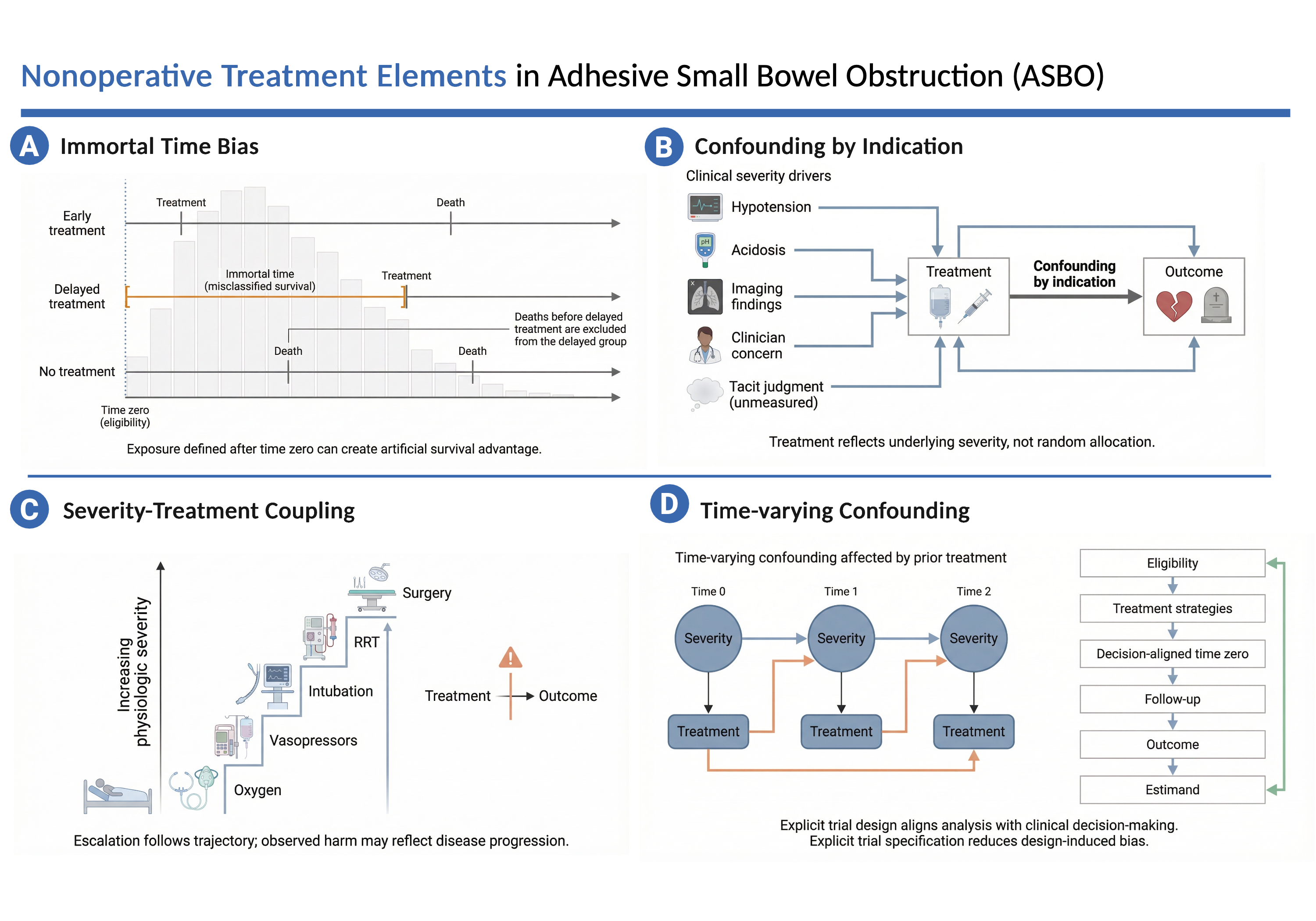
Embedded causal analyses defined by eligibility, time zero, treatment strategies, follow-up, and estimands.

Implementation and Systems Research

Studies of readiness, adoption, workflow, and barriers to evidence uptake in acute care environments.

Data Infrastructure

Standardized data capture, governance, and modular reporting aligned to protocols and outputs.

Methods

Target trial emulation is the central methodological frame.

Read methods

CESOR uses target trial emulation when treatment strategies, eligibility, time zero, follow-up, and estimands can be specified explicitly within observed care pathways. This avoids retrospective comparisons built on ambiguous treatment assignment.

Prospective platform design preserves the variable architecture required for causal analysis, including timestamps, pathway assignment logic, and downstream outcome ascertainment.

Target trial emulation diagram

Director

Gary A. Bass

Gary A. Bass

Gary A. Bass, MD, MSc, MBA, PhD, FEBS (Emergency Surgery)

Assistant Professor of Surgery and Assistant Professor of Biostatistics and Epidemiology, Perelman School of Medicine, University of Pennsylvania

Gary A. Bass directs CESOR and leads its work in emergency surgery outcomes research, multicenter platform design, causal inference, and implementation-focused study development.