
Methods

Target trial emulation is the intellectual anchor of CESOR.

CESOR uses prospective platform design to preserve the variable architecture required for observational and causal analysis. Method is part of the research structure, not a post hoc analytic layer.

Last updated: 2026-05-04

Target trial emulation is used when the causal question can be specified as a protocolized comparison of treatment strategies using observed care data.

The essential components are explicit eligibility criteria, a clearly defined time zero, treatment strategies stated before outcome accrual, a follow-up period aligned to strategy assignment, and a stated estimand. This framing reduces ambiguity in retrospective observational comparisons.
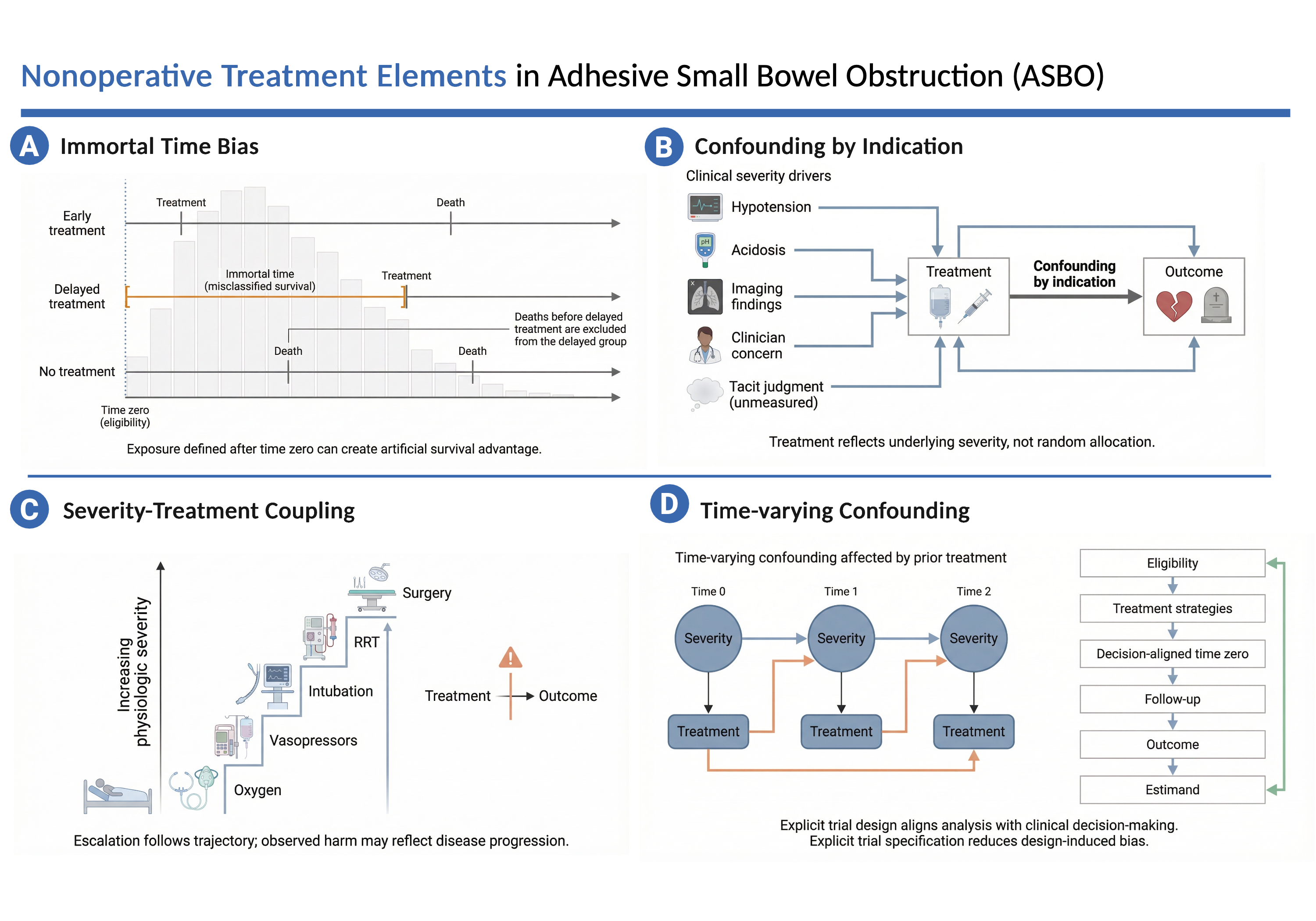
Target trial emulation framework diagram

Core pages

Methodological structure.

Target Trial Emulation

Explicit causal design in observational data.

  • Eligibility: define the clinical population at risk before treatment strategy comparison.
  • Time zero: align follow-up to the decision point at which strategy assignment becomes interpretable.
  • Treatment strategies: specify the strategies to be compared in clinically recognizable terms.
  • Estimands: define the population-level causal question before modeling.

Snapshot Study Design

Prospective consecutive capture under real-world conditions.

  • Time-bound multicenter inclusion windows preserve scalability.
  • Consecutive patient capture protects the denominator of acute presentation.
  • Standardized variable definitions improve comparability across sites.
  • Protocol-defined follow-up preserves downstream outcome ascertainment.

Causal Inference Frameworks

Bias is handled as a design problem first.

  • Immortal time bias: prevented by aligning time zero to strategy eligibility and assignment rather than later treatment receipt.
  • Confounding by indication: addressed by making treatment-selection structure explicit and collecting variables that preserve clinical decision context.
  • Selection processes: evaluated as part of platform design, not only during final analysis.
  • Estimand discipline: preferred over post hoc model-driven comparisons.

Data Governance

Standardization, version control, and public interpretability.

  • Platform structures are kept modular so platform records can be updated independently.
  • Outcome definitions, timestamps, and pathway constructs are preserved in protocol-aligned language.
  • Governance is summarized on public pages and specified operationally in platform protocols.
  • Outdated public material is replaced rather than allowed to compete with active program descriptions.

Design consequences

What this means in practice.

Platforms are built prospectively

CESOR platforms collect timestamps, pathway variables, and outcome structures that keep causal questions analytically legible.

Comparisons are not improvised later

Treatment strategies, time zero, and follow-up are treated as design requirements rather than retrospective conveniences.

Methods and platform design stay linked

Snapshot platforms are not separate from methodologic work. They are the substrate that makes the method usable.

Implementation questions are part of the program

Where evidence uptake depends on workflow, access, and readiness, CESOR treats those structures as research objects rather than background noise.